
Retirement planning is no longer optional. Rising living costs, medical expenses, and longer life expectancy make it important to build a reliable retirement fund early. One of the most popular retirement investment options in India is the National Pension System, commonly known as NPS.
Axis Bank offers NPS account services that help you start investing digitally with minimal paperwork. Whether you are salaried, self-employed, or a business owner, Axis Bank NPS can help you create a long-term retirement corpus while enjoying tax benefits under the Income Tax Act.
This article explains how Axis Bank NPS works, its benefits, eligibility, account opening process, investment options, tax savings, common mistakes to avoid, and practical examples to help you make informed decisions.
What is Axis Bank NPS?
Axis Bank offers access to the National Pension System, a government-backed retirement savings scheme regulated by the Pension Fund Regulatory and Development Authority.
Under NPS, you contribute money regularly during your working years. The invested amount grows through market-linked investments such as equity, government securities, and corporate bonds. After retirement, part of the accumulated corpus can be withdrawn, while the remaining amount is used to purchase an annuity that provides monthly pension income.
NPS is designed for long-term wealth creation and retirement security.
Why Many Investors Choose Axis Bank NPS
Axis Bank has become a preferred choice for NPS because of its digital onboarding process and accessibility.
Key reasons include:
- Online account opening
- Flexible contribution amount
- Low-cost retirement investment
- Tax-saving benefits
- Choice of pension fund managers
- Auto and active investment options
- Easy access through internet banking
Example:
A 30-year-old salaried employee investing Rs. 5,000 monthly in NPS through Axis Bank can potentially accumulate a retirement corpus of over Rs. 1 crore by age 60, assuming long-term market-linked returns around 10 percent annually.
Main Objectives of Axis Bank NPS
Retirement planning should have clear goals. Axis Bank NPS focuses on these objectives:
- Retirement Income Creation: NPS helps you build a dedicated retirement corpus for financial independence after retirement.
- Long-Term Wealth Accumulation: Regular contributions and compounding help your investments grow steadily over decades.
- Tax Savings: NPS offers additional tax deductions that can lower your taxable income every financial year.
- Financial Discipline: Monthly or yearly contributions encourage consistent saving habits.
- Flexible Investment Allocation: You can choose how your money is invested based on your risk appetite.
Benefits of Axis Bank NPS
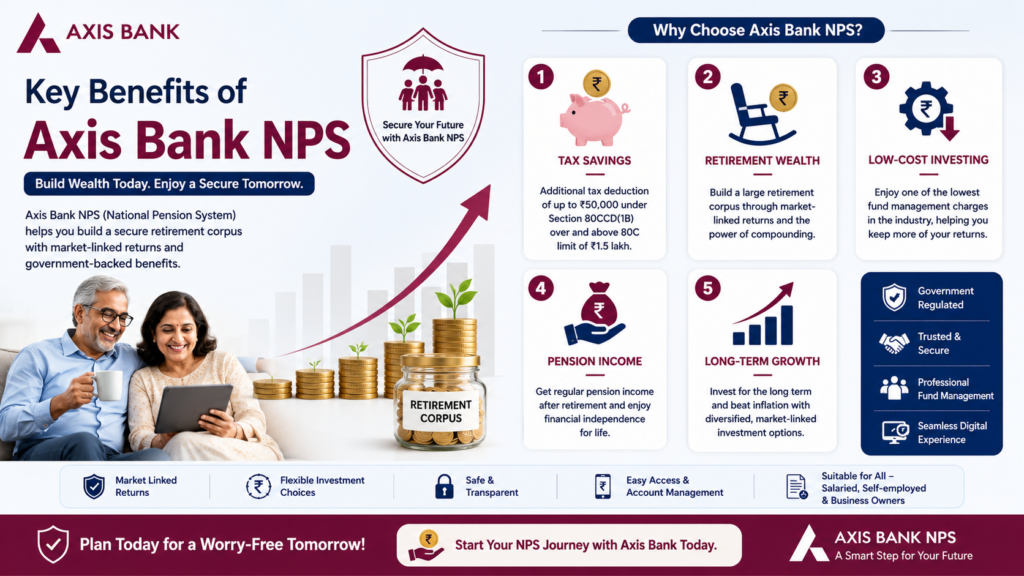
Tax Benefits Under Multiple Sections:
One of the biggest advantages of NPS is tax savings.
You can claim:
- Up to Rs. 1.5 lakh under Section 80C
- Additional Rs. 50,000 under Section 80CCD(1B)
- Employer contribution benefits under Section 80CCD(2)
This makes NPS one of the most tax-efficient retirement products in India.
Low Cost Investment Option
- Compared to many retirement plans and mutual funds, NPS has very low fund management charges.
Professional Fund Management
- Your investments are managed by professional pension fund managers approved by PFRDA.
Market-Linked Growth
- NPS invests in a mix of equity and debt instruments for potentially higher long-term returns compared to traditional savings plans.
Flexible Contribution
- You can contribute according to your financial situation.
- The minimum annual contribution is affordable for most investors.
Online Accessibility
- Axis Bank customers can manage NPS contributions and account details through digital banking platforms.
Types of NPS Accounts Available Through Axis Bank
Tier I Account
This is the primary retirement account.
Features:
- Mandatory for NPS investment
- Tax benefits available
- Partial withdrawal allowed under conditions
- Lock-in till retirement age
Tier II Account
This works like a voluntary savings account.
Features:
- Flexible withdrawals
- No lock-in period
- No mandatory yearly contribution
- Suitable for additional wealth creation
Eligibility Criteria for Axis Bank NPS
You can open an NPS account through Axis Bank if:
- You are an Indian citizen
- Your age is between 18 and 70 years
- You comply with KYC requirements
- Both salaried and self-employed individuals are eligible.
- NRI and OCI investors can also open NPS accounts subject to RBI and FEMA guidelines.
Documents Required for Axis Bank NPS
You generally need:
- PAN card
- Aadhaar card
- Passport-size photograph
- Mobile number
- Email ID
- Address proof
- Bank account details
How to Open an Axis Bank NPS Account
Online Application Process
Step 1:
Visit the official Axis Bank website or log into internet banking.

2: Choose the NPS under the investment section option and accept the terms and conditions.

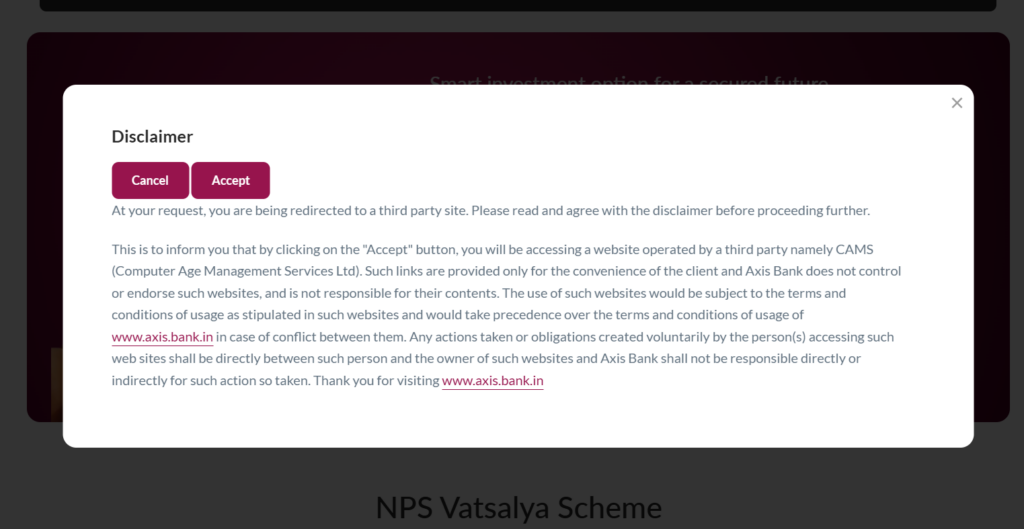
3: Fill in personal details and complete KYC verification.
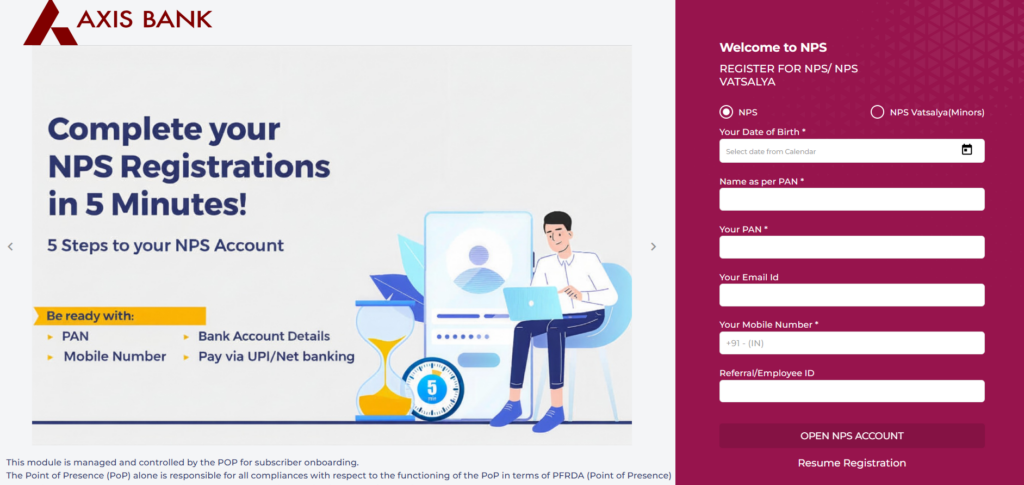
4: Select your pension fund manager and investment allocation.
5: Make the initial contribution.
6: Submit the application digitally.
Offline Application Process
You can also visit an Axis Bank branch and complete the registration form with supporting documents.
Investment Choices in Axis Bank NPS
Active Choice
You decide how your money is allocated across:
- Equity
- Corporate bonds
- Government securities
This is suitable if you understand investment risk and want greater control.
Auto Choice
- Asset allocation changes automatically according to your age.
- This option is ideal for beginners and conservative investors.
Real-Life Example of NPS Growth
Suppose you are 28 years old and invest Rs. 4,000 monthly in Axis Bank NPS.
Assuming a 10 percent annual return:
- Investment period: 32 years
- Total contribution: Around Rs. 15.3 lakh
- Estimated retirement corpus: Over Rs. 90 lakh
This example shows the power of compounding over long periods.
Axis Bank NPS Tax Benefits Explained
Section 80CCD(1)
You can claim tax deduction within the overall Section 80C limit of Rs. 1.5 lakh.
Section 80CCD(1B)
Additional deduction of Rs. 50,000 exclusively for NPS contributions.
This is over and above Section 80C benefits.
Section 80CCD(2)
Employer contribution to NPS is eligible for additional tax deduction.
Example:
If your annual taxable income is Rs. 12 lakh, investing in NPS can significantly reduce your tax liability.
Withdrawal Rules in Axis Bank NPS
At Retirement
- Up to 60 percent corpus can be withdrawn tax-free
- At least 40 percent must be used to buy an annuity
Partial Withdrawal
Allowed after specific conditions such as:
- Higher education
- Medical treatment
- Home purchase
Premature Exit
Different withdrawal rules apply if you exit before retirement age.
Who Should Invest in Axis Bank NPS?
NPS is suitable for:
- Salaried employees
- Young professionals
- Self-employed individuals
- Freelancers
- Business owners
- Tax-saving investors
- Long-term retirement planners
Common Mistakes to Avoid in Axis Bank NPS
- Ignoring Asset Allocation: Many investors choose allocation randomly without understanding risk.
- Tip: Review your equity and debt exposure according to age and financial goals.
- Starting Late: Delaying retirement investment reduces the power of compounding.
- Example:
Someone investing at age 25 usually builds a much larger corpus than someone starting at 40. - Contributing Irregularly: Skipping yearly contributions can impact long-term growth.
- Not Reviewing Pension Fund Performance: Review your pension fund performance periodically and switch if necessary.
- Focusing Only on Tax Saving: NPS should be part of your retirement strategy, not just a tax-saving tool.
Axis Bank NPS vs Traditional Savings Plans
| Feature | Axis Bank NPS | Traditional Savings Plans |
| Returns | Market-linked | Fixed |
| Tax Benefits | High | Moderate |
| Retirement Focus | Strong | Limited |
| Liquidity | Restricted | Moderate |
| Long-Term Growth Potential | Higher | Lower |
How to Maximize Returns in Axis Bank NPS
- Start investing early
- Increase contributions every year
- Stay invested long term
- Choose appropriate equity allocation
- Review performance annually
- Avoid premature withdrawals
Is Axis Bank NPS Safe?
NPS is considered relatively safe because:
- It is regulated by PFRDA
- Investments are diversified
- Government securities reduce overall risk
- Professional fund managers handle investments
However, returns are market-linked and not guaranteed.
Axis Bank NPS is a practical retirement planning solution for investors who want disciplined long-term wealth creation and tax savings. The scheme combines flexibility, affordability, and professional fund management in one retirement-focused investment option.
If you start early and contribute consistently, NPS can help you build a substantial retirement corpus over time. It works especially well for salaried employees and self-employed individuals looking to reduce taxes while securing future income.
Before investing, review your financial goals, risk appetite, and retirement timeline carefully. A well-planned NPS strategy can become an important pillar of your long-term financial security.
Read more